Preschool students are asked questions all day long. “What color is your shirt?” “Do you want Goldfish for snack?” “What is the weather outside?” These questions are great to gauge student knowledge, but they often have short, one-word answers.
The solution? Ask open ended questions! Why open ended? Open ended questions are subjective and have more than one answer. They promote creativity and critical thinking within students! Open ended questions also teach students that they is often more than one way to solve problems and questions.
Answering open ended questions helps vocabulary and oral language development within students. Research shows that oral language development directly relates to reading skills in the future (Lonigan, 2009). Providing open ended prompts is one of the most important things you can do as an early childhood educator!
Important Reminders
Give the child time to formulate a response! Early childhood students need processing time to come up with an answer. This is especially true when they are trying to use new vocabulary. Ask the student the question then let them think for a few seconds. If they don’t respond, either ask them again or rephrase your question.
You must respond to the child! Many teaching moments in the classroom are teacher driven. Times when students get the opportunity to speak are typically very short. These conversations do not provide many opportunities to use new vocabulary. By asking open ended questions and then continuing the conversation, you can allow students to hear and utilize new vocabulary words.
| Instead of… | Ask… |
| Did you like that story? | What was your favorite part of that story? |
| What is this dog’s name? | What can you tell me about this dog? |
| Can you use the bigger scoop to fill this up faster? | How do you think we can fill this up super fast? |
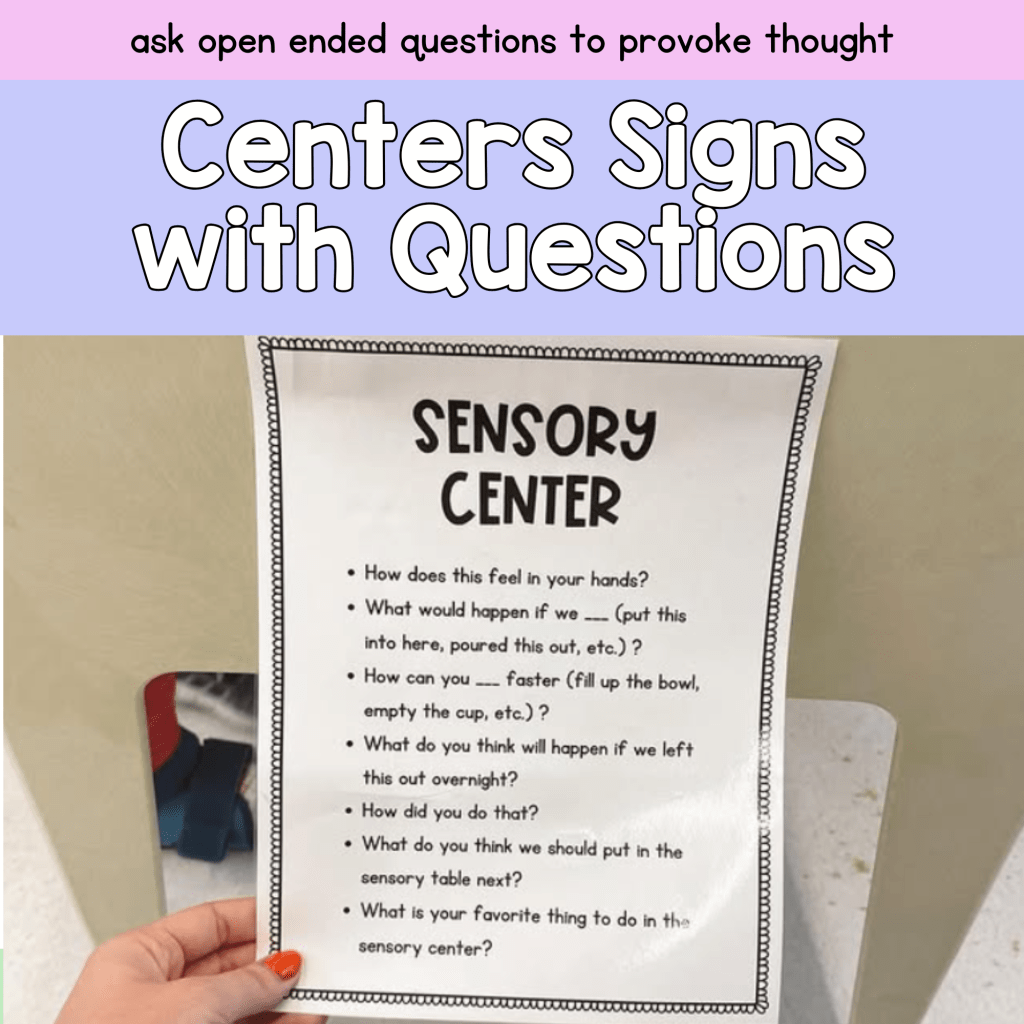
In my preschool classroom, we constantly have guests in and out! We have parents/guardians, substitute teachers/paraprofessionals, and others entering our room. Adding centers signs makes it so much easier for guests to know where everything is in our room. In addition to labeling the centers, I love to offer open ended questions for guests to ask the students. It takes the stress out of not knowing how to converse with children during centers time.
Click HERE to download the centers signs with questions FREE!
References:
Lonigan , C.J. ( 2007 ). Vocabulary development and the development of phonological awareness skills in preschool children . In R.K.E. Wagner , A.E.E. Muse , & K.R.E. Tannenbaum (Eds.), Vocabulary acquisition: Implications for reading comprehension (pp. 15 – 31 ). New York, NY : Guilford Press .


Leave a Reply